Tuesday, September 10, 2013

Hair Grass

Deschampsia

Deschampsia caespitosa ( Tufted Hair Grass )
A fast growing, finely textured grass, forming a semi-evergreen ( evergreen zones 7 to 9 ) foliage clump reaching a maximum size of 3.5 x 5 feet. It is native to North America ( from far northern Alaska to Nunuvat to Greenland; south to California to South Dakota to North Carolina ) as well as northern Eurasia. It is critically endangered in Indiana and Kentucky. Threatened in New Jersey. It was once widespread but localized throughout Pennsylvania though it now threatened in that state and completely absent from the middle. The Tufted Hair Grass is a cool season grass that grows mostly during spring and fall though remaining green during summer.
It is an excellent choice for mass plantings on wet sites.
The deep green leaves are very narrow, up to 0.2 inches wide.
The pale purplish-green flower panicles up to 10 inches in length, appear during mid-summer.
They are followed by loose, airy, hazy seed panicles, reaching up to 6 feet high.
This grass remains attractive during autumn and winter.
Hardy zones 4 to 9 ( likely 1 or 2 for seed source from the Northwest Terr. & northeast Alberta ) in sun or partial shade ( may need protection from hot afternoon sun ) on moist, well drained soil. Very soil tolerant including wet clays. Cut back ( to 1/3 height - more may damage the crown ) very early during spring before new growth begins. Dividing should also be done very early in spring.

* photos taken on Jul 17 2017 in Gatineau, Quebec

* USDA-NRCS PLANTS Database

* photo taken on Aug 7 2014 in Elkridge, MD

* photo taken on Oct 3 2025 in Howard Co., MD

* excellent video found on Youtube


'Bronze Veil'
Also called 'Bronzeschleier'.
Forms a tufted evergreen clump up to 4.5 x 5.5 ( rarely over 3 x 2.5 ) feet, topped with bronze-yellow inflorescences up to 4.5 feet during autumn.
The foliage is glossy rich mid-green.

* photos taken on July 30 2013 in Grand Bend, Ontario


'Golden Dew'
Moderate growing, reaching up to 2 x 2 feet.
The foliage is deep green.
The airy masses of golden-yellow flowers appear during early summer.
Hardy zones 4 to 9.

* photos taken on July 10 2023 @ Collingwood Arboretum, Collingwood, ON

* photos taken on May 6 2024 @ Brookside Gardens, Wheaton, MD

* photos taken on July 10 2024 @ Brookside Gardens, Wheaton, MD


'Gold Dust'
Forms a tufted evergreen clump up to 2 x 4 feet, topped with yellow flower inflorescences up to 5 feet during autumn.
Hardy zones 3 to 9

'Gold Veil'
Reaches up to 2 feet with bright yellow inflorescences.

'Golden Pendant'
Reaches up to 3 feet with golden-yellow inflorescences.

'Northern Lights'
Forms a foliage clump up to 1.5 x 2 feet, it does not flower.
The highly attractive foliage is boldly variegated with a white margin that turns to pink during fall and winter.

'Schottland ( Scottish Tufted Hair Grass )
Forms a tufted, deep green, evergreen clump up to 3.5 x 5 feet, topped with giant, bright green, airy inflorescences up to 5.5 feet during autumn.

'Tardiflora'
Reaches up to 3 feet with flower inflorescences borne during late summer.

Deschampsia flexuosa ( Tufted Hair Grass )
Reaches up to 1 x 1 foot, that is native to eastern North America ( from far northwest Minnesota to the north shore of Lake Superior to Haliburton, Ontario to central Quebec to Labrador, Newfoundland and Greenland; south to Wisconsin to central Tennessee to North Carolina ). It is endangered in Minnesota, Wisconsin, Ohio and Kentucky. It is found on rocky open woodland.
The leaf blades are up to 8 inches in length. The fine-textured foliage is bright green.
The golden-yellow flower inflorescences, up to 4.8 inches in length and up to 3.5 feet high are borne during mid to late summer.
An excellent groundcover and looks great planted with heather.
Hardy zones 4 to 9 ( 2 & 3 on very protected sites ) in full sun to partial shade on acidic moist soil though it is tolerant of temporary drought.

Wednesday, August 21, 2013

Hollyhock

Alcea

Alcea ficifolia ( Figleaf Hollyhock )
A very fast growing biennial ( often perennial if cut back after blooming ) reaching up to 7 x 3 feet, that is native to Siberia. It may act as a perennial if cut back to the basal foliage immediately after flowering.
The deeply 7-lobed leaves, up to 7 inches across, are mid-green.
The single or double flowers, up to 5 inches across, are borne on spikes during early summer.
Hardy zones 2 to 6 in full sun on well drained soil. It is moderately rust resistant.

Alcea pallida ( Eastern Hollyhock )
Similar to Alcea rosea but only reaching up to 6 x 2 feet and is native from central to southeastern Europe. It is also resistant to leaf rust unlike Alcea rosea. It is usually a biennial. The woolly foliage is grayish to gray-green.
The rosy-pink ( centered greenish-yellow ) flowers are borne early summer to early autumn.
Hardy zones 4 to 6.

Alcea rosea ( Common Hollyhock )
A large biennial, reaching up to 8 x 3 feet, though plants as large as 27 x 5 feet are known to have existed. It may have originated in the wild in Turkey however has been in cultivation for centuries. It no longer exists in the wild other than scattered locations around the world where it has escaped cultivation
The deeply-lobed leaves are up to 12 inches wide. The rough foliage is bright green.
The single or double flowers, up to 6 ( rarely over 4 ) inches across, are borne during much of the summer.
The flowers are variable in color ranging from white, yellow to pink, red or purple.
Hardy zones 3 to 6 in full sun on fertile, humus-rich, well drained soil. It may be prone to rust in regions with humid and hot summers. Seed can be sown early in a greenhouse or sown directly outdoors during mid-spring. Where rust is a problem, cut plants down to 6 inches after flowering and burn the prunings to get rid of spores which may overwinter.

* photos taken on Aug 4 2013 in Bayfield, Ontario

* photos of unknown internet source

* historical archive photo

* photos taken on July 14 2016 in Tobermory, ON

* photos taken on July 9 2022 in Bayfield, ON

* photo taken on May 2 2025 in Columbia, MD


'Chater's Pink'
Reaches up to 8 feet with double pink flowers.

'Chater's Scarlet'
Reaches up to 8 feet with double scarlet-red flowers.

'Chater's Violet'
Reaches up to 8 feet with double violet flowers.

'Chater's White'
Reaches up to 8 feet with double white flowers.

'Nigra'
Reaches up to 6 feet, with blackish-purple flowers.

'Old Farmyard'
Reaches up to 10 feet with large single flowers of various colors.

'Simplex'
Reaches up to 6 x 2 feet, bearing single flowers of various colors.

'The Watchman'
Reaches up to 6 feet, with deep blackish-red, single flowers borne all summer long.

Alcea rugosa ( Russian Hollyhock )
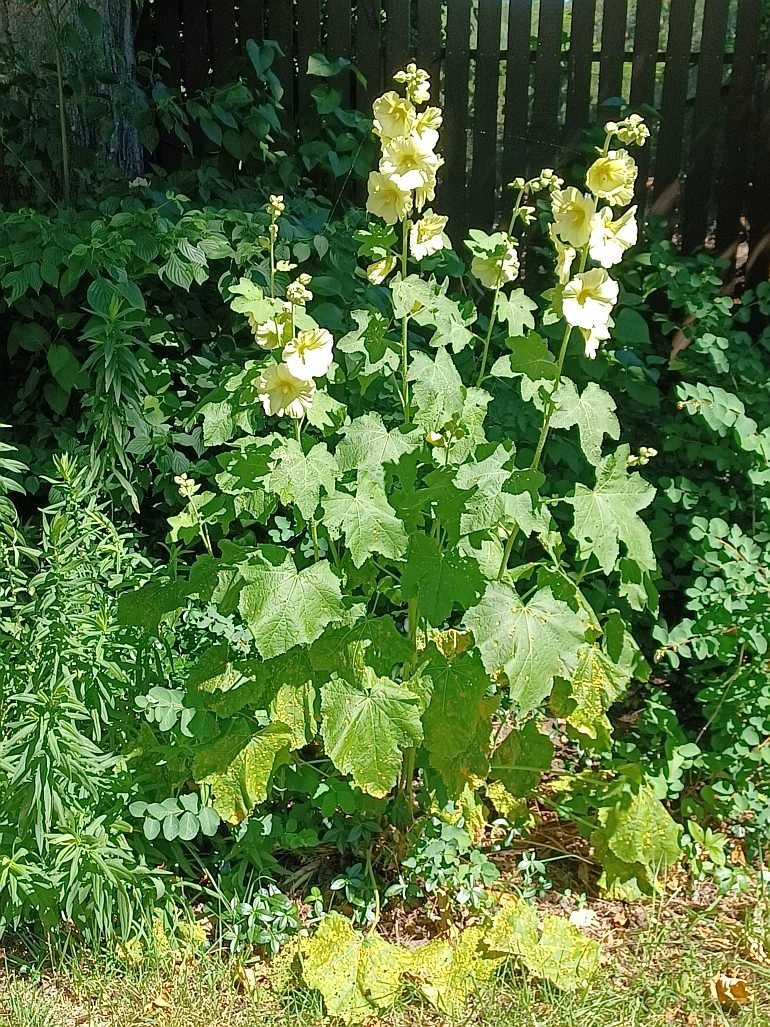
A biennial or short-lived perennial, reaching up to 9 x 3 feet, that is native to the Black Sea region in the Ukraine and Russia.
The foliage is gray-green.
The showy, single, mid-yellow flowers are borne along sturdy stocks from mid-summer well into fall.
Hardy zones 2 to 8 in full sun on well drained soil. It is drought tolerant and resistant to rust. It may self seed but not invasively.

* photo taken on Aug 1 2013 in Bayfield, Ontario

* photos taken on Aug 2 2013 in Stratford, Ontario
* photos taken on Aug 4 2013 in Bayfield, Ontario

* photo taken on Aug 24 2017 @ U.S. Botanic Garden, Wash. DC.

* photo taken on June 21 2025 in Howard Co., MD

Saturday, August 3, 2013

Culver Root

Veronicastrum

Veronicastrum sibiricum ( Siberian Culver Root )
Very similar to Veronicastrum virginica, except for having broader leaves ( up to 6 x 2 inches ) and blue flowers on thicker spikes. It is native from eastern Siberia to Sakhalin; south to northern China to Japan. Hardy zones 3 to 8.

* photo taken on Jul 18 2017 @ Dominion Arboretum, Ottawa, ON


Veronicastrum virginicum ( American Culver Root )
Also called Veronica virginicum. A perennial, forming an impressive large clump, up to 7 x 4 feet, that is native to rich woods and swamps in northeastern North America ( from southeast Manitoba to International Falls to Michigan's Upper Peninsula to southern Ontario to western New York State to southern Maine; south to far eastern Oklahoma to central Mississippi to central Georgia ). In the Windsor/Essex County, Ontario region; it was abundant at Detroit, the Detroit River islands, the Ojibway Prairie in Windsor as well as the Ohio shore during the 1800s. Slow to establish, taking a few years but worth the wait.
The sharply-toothed, lance-shaped leaves, up to 6 x 1 inches in size, are arranged in whorls of 4 to 7 around the stems. The foliage is deep green.
The small white flowers are borne on long wands, up to 10 inches in length, from mid-summer into early autumn.
The flowers attract butterflies and honey bees.
Hardy zones 3 to 8 in full sun to partial shade on moist to wet, acidic, fertile, well drained soil. Too much shade will cause plants to be spindly and flop over. Lack of drainage during winter may cause loss of plants.
Pest and disease problems do not normally occur, though rare cases of mildew and leaf spot are known.
Propagation is from seed or division during fall or spring. New plants are best installed during spring before active growth begins.

* photos taken on July 1 2010 in Columbia, MD


* photo taken on Aug 5 2017 @ Brookside Gardens, Wheaton, MD

* photo taken on July 16 2018 @ Wye Marsh, Midland, ON

* photo taken on Sep 15 2020 in Columbia, MD

* photo taken on Nov 10 2020 @ Brookside Gardens, Wheaton, MD

* photo taken on June 1 2022 in Columbia, MD

* photo taken on July 10 2024 @ Brookside Gardens, Wheaton, MD

* historic archive photo


'Album'
Pure white flowers, otherwise identical.

* photo of unknown internet source

* photos taken on June 30 2013 @ U.S. National Arboretum, DC


'Apollo'
Reddish-purple flowers; otherwise identical to species.

'Fascination'
Reaches up to 6 feet with lilac-pink flowers borne in long racemes up to 15 inches in length.
Attractive deep green foliage.

'Lavender Tower'
Lavender flowers

* photo taken @ U.S. Botanical Garden, Wash., DC on Aug 25 2014


'Lilac Carina'
Lavender-blue flowers.

* photo taken on July 1 2011 in Columbia, MD


* photos taken on June 28 2022 in Columbia, MD


'Rosea'
Reaches a maximum size of 7 x 4 feet with pale pink flowers borne in long spikes form mid-summer into early autumn.

* photos taken on Aug 2 2013 in Stratford, Ontario